Hero webapp

The new Health Ecosystem 
for reducing NCDs

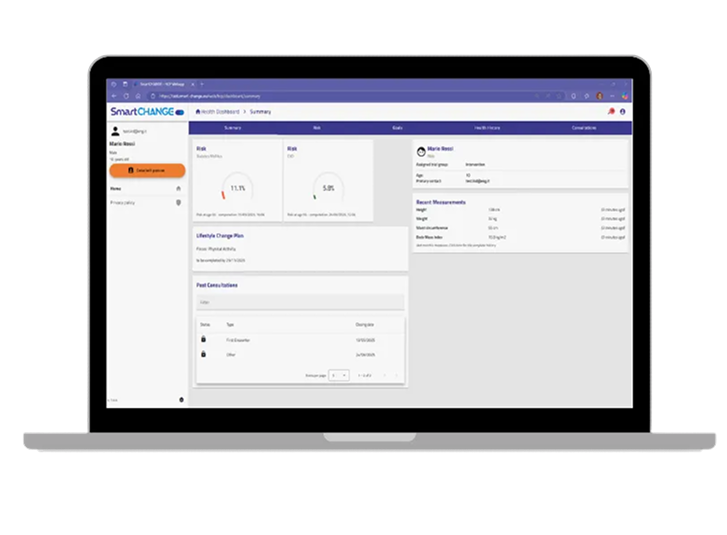
A unified dashboard for the next generation of pediatric care. Monitor progress, analyse risk factors, and implement evidence-based interventions supported by the latest research in behavioural nutrition and physical activity.

How does it work?

Advanced NCD Risk Assessment

Transform data from wearables, questionnaires, and clinical encounters into long-term health forecasts. Our machine learning models provide a clear, colour-coded overview of cardiovascular and metabolic risks, helping you identify concerns before they become non-communicable diseases.

Explainable AI & "What-If" Analysis

Our Explainable AI breaks down specific risk contributors, like sleep or diet, and allows you to run "what-if" simulations to show patients exactly how targeted behaviour changes can lower their risk scores.

Seamless Goal Synchronisation

Set personalised targets in the web app that sync directly to the child's HappyPlant! app. Monitor real-time progress through automated charts and data logs, allowing for a continuous, bi-directional feedback loop between the family and the clinic.

Validating our solution: international Feasibility Study

SmartCHANGE is built on a participatory approach, bringing together children, families, and healthcare professionals to co-create tools that actually work in clinical practice. Through five study sites, we are testing the feasibility and impact of our AI-driven ecosystem across diverse healthcare settings, ensuring our solutions are inclusive, usable, and medically effective.

The Netherlands

School setting involving secondary school students (age 11-14) and preventive Youth Healthcare setting involving physicians and school nurses.

Finland

School setting facilitated by school nurses involving 11 and 14 year-olds.

Slovenia

A community program with coordinated healthcare support for children ages 6–10.

Portugal

Family setting facilitated by paediatricians. Focusing on kids 6 to 10 year-olds.

Taiwan

Validation of the Finnish Study Site in a non-European setting.

A complete ecosystem for proactive pediatric care

The SmartCHANGE platform bridges the gap between clinical assessments and daily life. By integrating data from the HappyPlant! mobile app, wearable devices, and clinical encounters, the system provides a 360-degree view of a patient’s health. Our advanced machine learning models don't just predict risk, they provide explainable insights and actionable goals, empowering you to guide families toward lasting lifestyle changes through a single, intuitive interface.

Watch the full demo
webapp

Frequently Asked Questions

The SmartCHANGE platform uses advanced machine learning models trained on long-term health data. These models predict cardiovascular and metabolic risks by analysing physical measurements, lab results, and lifestyle data collected via the HappyPlant! app and wearables. 

The system generates patient profiles that are somewhat different from the real one and then recalculates the risk to show how small changes in lifestyle and other health-related variables affect long-term health risk. 

Yes. Instead of a "black box" score, the app provides "Health Factor Impact" charts. These visualise exactly which variables, such as BMI, sleep duration, or nutrition, are contributing most to a patient's current risk level. 

The platform follows strict GDPR and ethical research protocols. All data flows lead to storage in a centralised clinical repository, designed to securely hold FHIR resources for health information. The repository ensures data integrity and controlled access for authorised authorities. Physically, identification details such as name, surname and contact information are stored in a separate database from the rest of the clinical data, and the information is reconstructed on the fly upon request of authorised services and users.

Data within the clinical repository is stored for the duration necessary to fulfil the objectives of the activity, in accordance with regulatory and ethical standards. After this period, data will be deleted based on predefined retention policies (i.e., proprietary data, data generated for testing purposes, data of low value), whereas other types (e.g., software code, deliverables) will be maintained for at least five years after the end of the project. Finally, all data is stored within each clinical pilot site and follows the ENISA guidelines

By default, clinical data is private. It only becomes visible to a healthcare professional (HCP) once the family explicitly grants permission through the HappyPlant! app. Administrators and clinicians manage these permissions based on the family's ongoing consent. Within the overall solution, access to data, or a specific subset of it, is granted based on the user's defined role and the agreement between the HCP and the individual. In all cases, individuals are required to provide their formal consent before personal data is shared with any healthcare professional.

Data used for the broader SmartCHANGE research project is anonymised. Within the clinical dashboard, you see the specific data for patients under your care to facilitate personalised treatment. 

No. The professional tool is a web-based application accessible through any browser, making it easy to use across different hospital or school clinic workstations. 

The system features bi-directional synchronisation. Goals you set in the web app are stored in the Central Repository, where the  HappyPlant! app can retrieve them. Conversely, data logged by the child or their wearable, such as a Garmin, is stored in the repository and available to be consulted through the web dashboard. 

Yes, among the key functionalities of the web app, it is possible to record data collected during physical exams through a guided workflow. 

Yes. System administrators can assign HCP profiles to one or multiple organisations, allowing you to switch between different schools or hospital settings, if needed. HCPs can only access data from users within their own organisations. 

If a patient stops using their wearable, no new data is recorded or sent to the web app. However, HCP can still view the data history, allowing them to see exactly up to which point data was being recorded. 

Get involved

If you are interested in integrating our clinical decision-support tools into your school or healthcare setting, get in touch.

Contact us
Hands shaking